Sensation quantique : l’expo qui va faire sensation au printemps
Mystérieuse, abstraite et contre-intuitive, la physique quantique stimule nos esprits. Aurore, Caroline et Céline, physicienne, artiste et philosophe s’associent pour créer une exposition multisensorielle éclairant la recherche en science quantique.
En s’appuyant sur les expériences d’Aurore-Alice Young, doctorante au laboratoire Kastler Brossel, Caroline Delétoille vient poser son regard d’artiste sur la recherche en cours. Des observations qui prennent vie sous la forme de dispositifs sonores et de peintures à la Maison Poincaré du 10 avril au 26 juillet 2025.
Au cœur des productions artistiques, se créer un parallèle exigu entre la physique quantique et la mémoire. Une prouesse artistico-scientifique qui ne manque pas d’éveiller vos sens et de vous transporter dans le monde animé de la recherche.
La Société Française d’Optique vous invite à candidater au prix Jean Jerphagnon avant le 31 mars 2025.
Le prix Jerphagnon tend à honorer la mémoire et les travaux de Jean Jerphagnon en optique et en photonique. Cette récompense promeut l’innovation technologique et la diffusion de l’optique et de la photonique dans divers domaines d’applications.
Le prix est décerné par un jury sous la direction d’Alain Aspect, Prix Nobel de Physique 2022, et la dotation est de 10 000€ pour le lauréat.
Toute l’équipe du DIM QuanTiP vous souhaite de très belles fêtes de fin d’année et vous présente ses meilleurs vœux de santé, de bonheur et de réussite pour l’année 2025.
Que cette nouvelle année « quantique » soit riche en projets et en accomplissements.
On vous donne rendez-vous en janvier 2025 pour de nouveaux événements et appels à projets !
Cette année le DIM QuanTiP propose sur son LinkedIn un « Qualendrier de l’avent », tous les jours un jeu, une énigme, un quiz, ou une devinette ! Jouez avec nous : DIM QuanTiP | LinkedIn !
La région Île-de-France : nouvelle scène internationale du calcul quantique
Le plan d’investissement France 2030 soutien la création d’une Maison du Quantique en région Île-de-France !
En début d’année, les acteurs de la recherche quantique, se sont mobilisés pour répondre à l’appel à projet de France 2030. Un regroupement qui s’avère être payant puisque début octobre, la réponse a été favorable.
Le DIM QuanTiP aux côtés de PCQT, Quantum Saclay, iXCampus, Sorbonne Université et CEA-list, est très fier de soutenir et de s’impliquer dans le socle fondateur d’un écosystème quantique régional. L’objectif de la Maison du Quantique est de fournir des lieux fédérateurs pouvant accueillir des équipements de pointe en calcul quantique. Un moyen de développer l’industrialisation en donnant accès à des ressources humaines et matérielles aux entreprises.
La dynamique autour de la Maison du Quantique permettra aussi au territoire de s’illustrer dans le domaine du calcul quantique et d’en faire un lieu international inéluctable.
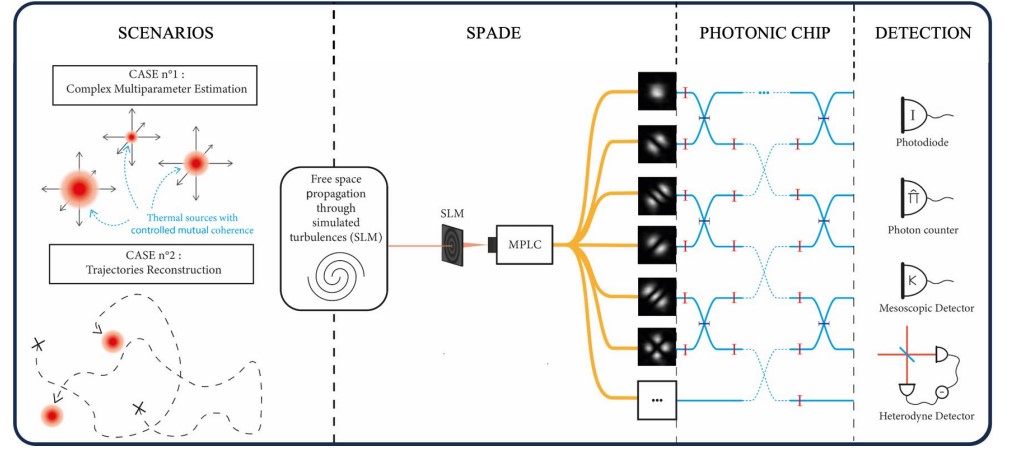
It was long believed that the ultimate resolution limit in imaging was dictated by the Rayleigh criterion, which states that two point sources are indistinguishable when their images overlap excessively. This diffraction limit, often considered a fundamental barrier in conventional imaging systems, posed a significant challenge for resolving closely spaced objects. However, recent advances in quantum metrology have revealed that the Rayleigh limit is not a fundamental boundary [1]. Employing non-conventional imaging techniques, inspired by quantum metrology, it is possible to achieve super-resolution imaging, surpassing the classical resolution limits [2,3]. One such approach is pursued in the PESto experiment at LKB, where Spatial Mode Demultiplexing (SPADE) is used. The light from two point sources is demultiplexed into a basis of Hermite-Gaussian spatial modes. Detecting and counting photons in each spatial mode of the multimode light, the distance between the two point sources is estimated with a precision approaching the quantum limit [4], order of magnitudes better than the Raileigh limit.
In practical imaging scenarios, multiple parameters must often be estimated simultaneously, making the problem more complex [5]. Notably, the SPADE technique is only quantum-optimal when only one parameter is to be estimated, and the others, such as the centroid of the source distribution, the relative intensity between the sources 0r even the number of sources, are known. This PhD project aims to extend the capabilities of SPADE to more realistic scenarios, incorporating multi-parameter estimation, low-flux detection down to the single photon level, and the effects of environmental factors such as optical turbulence. Addressing these complexities requires the integration of machine-learning techniques to optimize the choice of spatial modes, extract multiple parameters from the data efficiently, and ensure robustness against experimental imperfections. Additionally, in scenarios involving dynamic or moving sources—where only limited information can be gathered in real-time—a Bayesian approach to estimation will be explored to track the sources effectively.
This research will focus on advancing super-resolution imaging in realistic conditions, providing solutions to the challenges of multi-parameter estimation and developing methods to handle experimental imperfections and source motion. By working on both experiment and theory, leveraging estimation theory -classical and quantum-, machine learning and Bayesian techniques, the goal is to achieve unprecedented imaging precision and pave the way to a new paradigm in imaging.
[1] Tsang, M., Nair, R., & Lu, X. M. (2016). Quantum theory of superresolution for two incoherent optical point sources. Physical Review X, 6(3), 031033. [2] Gessner, M., Treps, N., & Fabre, C. (2023). Estimation of a parameter encoded in the modal structure of a light beam: a quantum theory. Optica, 10(8), 996-999. [3] Sorelli, M. Gessner, M. Walschaers, and N. Treps, Quantum limits for resolving Gaussian sources, Phys. Rev. Research 4, L032022 (2022). [4] Rouvière, C., Barral, D., Grateau, A., Karuseichyk, I., Sorelli, G., Walschaers, M., & Treps, N. (2024). Ultra-sensitive separation estimation of optical sources. Optica, 11(2), 166-170. [5] Řehaček, J., Hradil, Z., Stoklasa, B., Paúr, M., Grover, J., Krzic, A., & Sánchez-Soto, L. L. (2017). Multiparameter quantum metrology of incoherent point sources: towards realistic superresolution. Physical Review A, 96(6), 062107. [6] C. Fabre and N. Treps, Modes and States in Quantum Optics, Rev. Mod. Phys. 92, 035005 (2020).
Missions The recruited person will participate in various ongoing projects within the Diamond and Carbon Materials (DCM) team focusing on the integration of diamond layers in devices for power electronics (PEPR Électronique FrenchDiam) and quantum technologies (ANR projects TRAMPOLINE and SINFONIA). These projects require, initially, to master the process of developing single crystal diamond layers doped with boron, for integration into vertical power components, and doped with nitrogen, for the creation of colored centers with quantum properties that can be exploited in different fields, notably in magnetometry. Secondly, the design of demonstrators using clean room technologies should make it possible to link the physicochemical and usage properties of diamond single crystals to the characteristics of electronic and quantum devices and to demonstrate the added value of diamond compared to conventional materials.
Activities The post-doctoral fellow will ensure the running of research projects by participating in the various planned tasks, in particular:
Optimization of the process for producing single crystal diamond layers doped with boron and nitrogen;
Physico-chemical and microstructural characterization of the layers produced (SEM, optical microscopy, Raman spectroscopy, electrical measurements, ODMR, etc.);
Micro- and nano-manufacturing in clean rooms;
Characterization of the electronic and quantum demonstrators produced. Skills
Work context The work will be carried out at the Process and Materials Sciences Laboratory, CNRS LSPM UPR3407, on the Villetaneuse campus (University Sorbonne Paris Nord). The postdoctoral fellow will work within the PPANAM axis (Plasma Processes, Nanostructures and Thin Films) and more particularly the DCM Research operation (Diamond and Carbon Materials). The position is located in a sector falling under the protection of scientific and technical potential (PPST), and therefore requires, in accordance with regulations, that your arrival be authorized by the competent authority of the MESR.
Internship Description: The master student will participate in cutting-edge experiments aimed at ultra-precise measurements of rovibrational molecular transitions and dedicated to measuring/constraining the potential time variation of the proton-to-electron mass ratio (µ), a fundamental constant of the standard model (SM). Such variations, if detected, would be a signature of physics beyond the SM, providing insights into the nature of dark matter and dark energy. The idea here is to compare molecular spectra of cosmic objects with corresponding laboratory data. The experimental setup is based on quantum cascade lasers (QCLs) locked to optical frequency combs, with traceability to primary frequency standards, a breakthrough technology developed at Laboratoire de Physique des Lasers (LPL), allowing unprecedented spectroscopic precision in the mid-infrared range. This internship will focus on measuring mid-infrared molecular transitions of methanol (CH3OH), a molecule known for its enhanced sensitivity to changes in µ. The student will set up and stabilize a new QCL in a spectral region hosting particularly relevant transitions. The work will involve achieving sub-Doppler spectroscopic resolution to reach target laboratory frequency accuracies of ~100 Hz needed for comparisons with astronomical observations. This activity is part of the ANR Ultiµos project, a collaborative effort which seeks to refine current constraints on the possible variation of µ which involves leading research institutions, including Laboratoire Kastler Brossel (LKB, L. Hilico) and MONARIS (C. Janssen) at Sorbonne Université. The three partners of the Ultiµos consortium will collaborate to conduct measurements in methanol and other species such as ammonia (NH3) in different spectral windows, to identify transitions as targets for future Earth/space comparison campaigns, which could further tighten constraints on variations of µ. Other collaborators, such as Vrije Universiteit Amsterdam and Onsala Space Observatory, will provide theoretical and observational/astronomical support to complement the experimental efforts. The proposed laser technology is also crucial for the ongoing development at LPL of a new-generation molecular clock specifically designed for precision vibrational spectroscopy of cold polyatomic molecules. The student may therefore be involved in first precise spectroscopic measurements on cold molecules produced at ~1 K in a novel cold molecule apparatus. Combining frequency metrology and cold molecule research as the potential to bring even more stringent constraints on a drifting-µ, and opens possibilities for using polyatomic molecules to perform other fundamental tests, including the measurement of the energy difference between enantiomers of a chiral molecule, a signature of parity (left-right symmetry) violation, and a sensitive probe of dark matter. Keywords: fundamental constants, standard model, precision measurements, ultra-high-resolution spectroscopy, frequency metrology, quantum cascade lasers, frequency comb lasers, cold molecules, molecular physics, quantum physics, astrophysics, optics & lasers, vacuum, electronics, programming & simulation Relevant publications from the team: Tran et al, APL Photonics 9, 3, (2024); Fiechter et al, J Phys Chem Lett 13, 42 (2022); Santagata et al, Optica 6, 411 (2019); Cournol et al, Quantum Electron. 49, 288 (2019), arXiv:1912.06054; Tokunaga et al, New J. Phys. 19, 053006 (2017); Argence et al, Nature Photon. 9, 456 (2015), arXiv:1412.2207.
Requirements:
The applicant should be doing its master studies in a relevant area of experimental physics or chemical physics: atomic, molecular and optical physics, spectroscopy, lasers, quantum optics. Interested applicants should email a CV, a brief description of research interests and the contact details of 2 referents to M. Manceau (mathieu.manceau@univ-paris13.fr) and/or B. Darquié (benoit.darquie@univ-paris13.fr). Funding is already secured for a potential PhD following the internship
Rare-earth ions (REI) present a strong interest for quantum technologies due to their ability to show long-lived quantum superposition states both in their optical and spin transitions. The perspective of using them for applications such as quantum information processing, quantum memories and indistinguishable photon sources, however, relies on developing host materials in which their outstanding quantum properties are preserved, while enabling integration into nanophotonic devices. Several proof-of-concept experiments based on rare-earth doped oxide crystals have been reported [1], [2], yet, integration into practical and scalable quantum devices has still not been stablished. In particular, specific designs compatible with both optical cavities and MW architectures are generally needed [3], [4]. In this context, the ability to host REI into thin oxide films deposited on a scalable substrate such as silicon would greatly facilitate the development of such resonators. A thin film architecture also allows flexibility in material composition or dopant spatial localization and offers integration perspectives with silicon photonic chips by standard clean room processing technologies[5], [6]. As a drawback, the obtention of high-crystalline quality oxide films on silicon is very challenging with most deposition techniques. Moreover, the optical and spin properties of REIs in thin films tend to lag behind that of their bulk counterpart, mainly due to the close proximity of surface and the presence of interfacial defects. To overcome these challenges, we have developed a hybrid thin film fabrication approach combining MBE [5] and CVD [7] deposition techniques to obtain epitaxial rare-earth oxide thin films on silicon (Fig. 1). The optical properties of europium ions embedded in this film matrix have already shown promising results with sub-MHz homogeneous linewidths measured.
This internship will have two main objectives:
(i) the optimisation of the thin-film deposition conditions towards the reproducible obtention of smooth epitaxial Y2O3 thin films doped with REI. (ii) the fabrication of Y2O3 membranes by both dry and wet chemical etching techniques. The Gd2O3 200 nmSi Y2O3 200 nm 1 μm deposited thin films, and membranes quality and eligibility for quantum technology applications will be assessed by the candidate using different morphological and optical characterizations.
Leader in the development of measurement technics and references, with a strong reputation in France and abroad as National Metrology Institute, the Laboratoire National de Metrologie et d’Essais (LNE) supports industrial innovation and is a key player in making the economy more competitive and society safer through reliable and harmonized measurements.
As the driving force behind French metrology, our research lies at the heart of our public service mission, and is a fundamental factor in supporting the academic world and the competitiveness of companies, through ever more reliable measurements on innovative subjects such as artificial intelligence, nanotechnologies and quantum technologies.
Context: One of the main current challenges in quantum electrical metrology is to simplify the operating conditions of quantum electrical standards and the implementation of associated instrumentation, in order to make the electrical units of the International System of Units (SI) more accessible. As part of new developments in metrology, LNE and its partners are seeking to exploit the great potential of van der Waals heterostructures, particularly those based on graphene bilayers with control of the angle between the layers (“Twistronics”), to develop new quantum electrical standards and ultra-sensitive detectors (SQUID, electron and single photon). The ultimate aim is to combine them on a chip within a single “quantum multimeter”.
Missions: Working in LNE’s fundamental electrical metrology department, you will contribute to research activities in the field of quantum electrical metrology. Your main missions will be to: – Contribute to current work and projects in quantum metrology (quantum (anomalous) Hall and Josephson effects) in graphene and in innovative materials such as heterostructures based on graphene and hexagonal boron nitride (h-BN) at the so-called “magic angle” (MATBG, for “magic angle twisted bilayer graphene”); – Contribute to the engineering of the associated quantum standards and detectors (design, modeling, etc.) and their instrumentation (particularly cryogenic) for simplified operation; – Analyze and interpret the data obtained, in conjunction with existing theoretical models; – Ensure reporting and promoting results through scientific communications (publications, conferences, etc.), metrological good practice guides, and potentially through actions aimed at industrializing the technologies developed, e.g. by registering patents. – Supervise a PhD student and/or a post-doctoral fellow, to work in close interaction with the current team, and possibly to welcome visiting scientists. – Be able to fit your work into research and innovation programs (EURAMET EPM, Horizon Europe, ANR, etc.) and have the ability to develop collaborations with academic and industrial partners, using your own and/or the team’s network.
Profile: – PhD degree in condensed matter physics, mesoscopic physics/quantum transport and/or quantum physics; – Strong experience in low-noise electronic transport measurements at (very) low temperatures. Interest in experimental science, measurement, instrumentation and technological and applied research; – Knowledge of quantum effects: Josephson and quantum (anomalous) Hall effects. Specific knowledge of graphene physics would be highly appreciated; – Ability to analyze results and synthesize information; – Pragmatic by nature, rigorous, critical and self-reliant; – Enjoy teamwork, and able to organize yourself to take part in several projects (at LNE and in European projects); – Fluency in scientific English for the promotion of work (writing articles, conferences, meetings, etc.) and collaboration with the project’s European partners. – Occasional travel required for scientific exchanges (project meetings with European partners, international conferences, etc.) in Paris and Paris area, France, Europe and abroad. Joining LNE means: – Joining an international group with nearly 1,000 employees. – Participating in the development of a Public Industrial and Commercial Institution (French acronym EPIC) that has been serving society and citizens since 1901. – Joining a company that supports local authorities and industry in meeting tomorrow’s social and environmental challenges. – Join a research organization involved in European and international projects. – Join a company that places respect and fairness at the heart of its HR policies. – Join a company that is committed to a CSR policy and has set up a sustainable mobility package. – Join a company that offers personalized introduction and regular training. – A 12-month fixed salary plus an annual end-of-year bonus. Executive status with a 205-day fixed salary and numerous benefits. A profit-sharing bonus and an employee savings plan (PEE/PERCO) with matching contributions. – Possibility of teleworking in accordance with the company agreement in force. – Mutual insurance* and provident scheme*. – Access to the company restaurant directly on our Trappes site. – Access to a wide choice of offers through our social and economic committee (CSE).
*under the conditions set out in the agreements and their amendments.
To apply, send your CV and covering letter to: recrut@lne.fr, quoting job reference ML/MEQ/DMSI in the subject line.