Call for Collaborative Projects – Disruptive Innovation and Industrial Resilience (IRRI)
The Île-de-France Region supports disruptive innovation by fostering collaborations between SMEs, startups, mid-sized companies, large corporations, and research laboratories, with the aim of strengthening the region’s industrial and technological resilience.
The European Research Council (ERC) has announced the winners of Proof of Concept 2026, a program that supports the early stages of commercialization projects, and the results are positive for laboratories in the network!
Congratulations to Hugo Defienne (INSP), Ivan Favero (MPQ), Julie Grollier (LAF), and Mathieu Mivelle (INSP)!
Quantum Physics: the Heart of Paris Cité University
Paris Cité University unveils its new website entirely dedicated to quantum science and technology!
As the Paris region continues to prioritize quantum science, Paris Cité University is taking the lead by bringing together all its initiatives related to the field on a single website. For years, the Paris-based university has been a driving force in the quantum field. Its research teams cover all major academic topics, from quantum computing to quantum sensors and from simulations to quantum communication.
With the goal of bringing all these projects together, the “Quantum UPCité” website has been launched. There, you can find all the information on the various networks, projects, and latest publications.
Christophe Daussy, winner of the Jean Perrin Prize
Christophe Daussy, a researcher at the Laser Physics Laboratory and close collaborator of the DIM QuanTiP, has been honored by the French Society of Physics for his dedication to the dissemination of scientific knowledge.
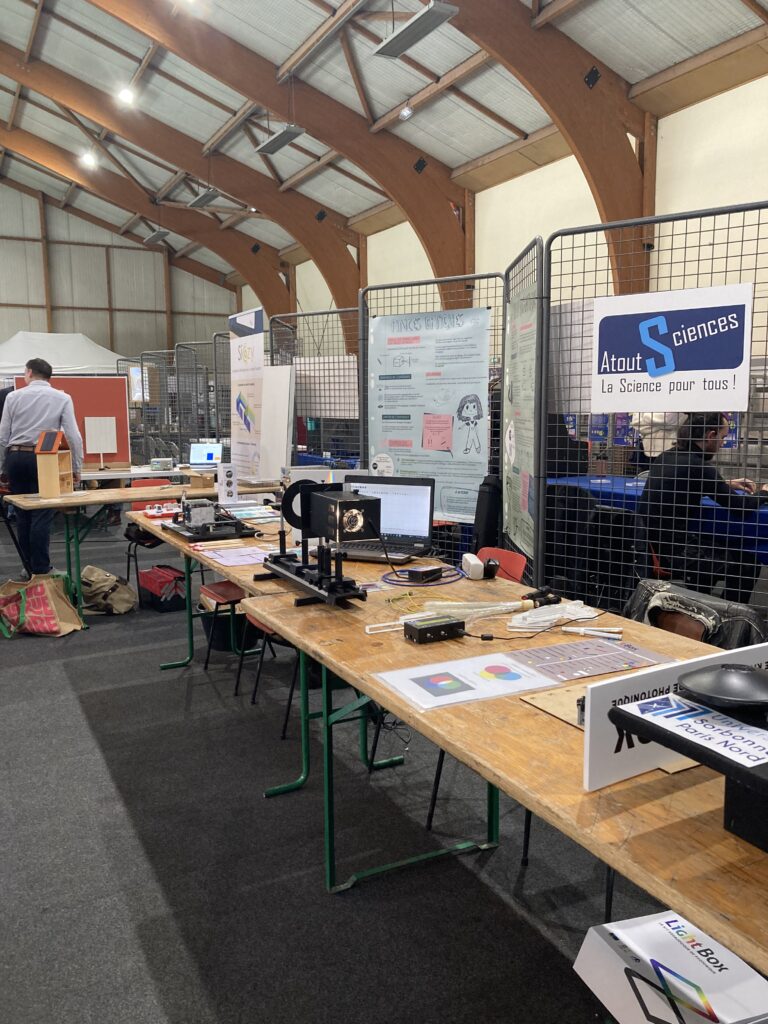
In a corridor on the ground floor of the Sorbonne Paris Nord University, there are two very surprising rooms. In the first, there are many objects, some more worn than others. A few lie in a corner of the room, requiring some searching to find them, while others are meticulously classified on shelves with countless drawers. In the second room, it is as if a whole host of scientific experiments have been stored in one place. On large wooden tables, they are lined up perfectly one behind the other: a Paul’s trap, a laser fountain, a mirascope. So many treasures in such a small space. At the heart of the University, it’s like a breath of fresh air between two classrooms. It’s a laboratory where we create, where we share, where imagination has a place. It’s the stage for a unique show. It’s Atouts Sciences.
Ten years ago, Christophe Daussy founded Atouts Sciences, an association dedicated to democratizing science, whose goal is to convey a passion for physics with enthusiasm and kindness. Today, the French Physics Society has awarded him the Jean Perrin Prize for developing and implementing several outreach initiatives, starting with the creation of a MOOC accessible to high school students, which aims to introduce them to the riches of physics through a clever mix of science, pop culture references, and everyday applications.
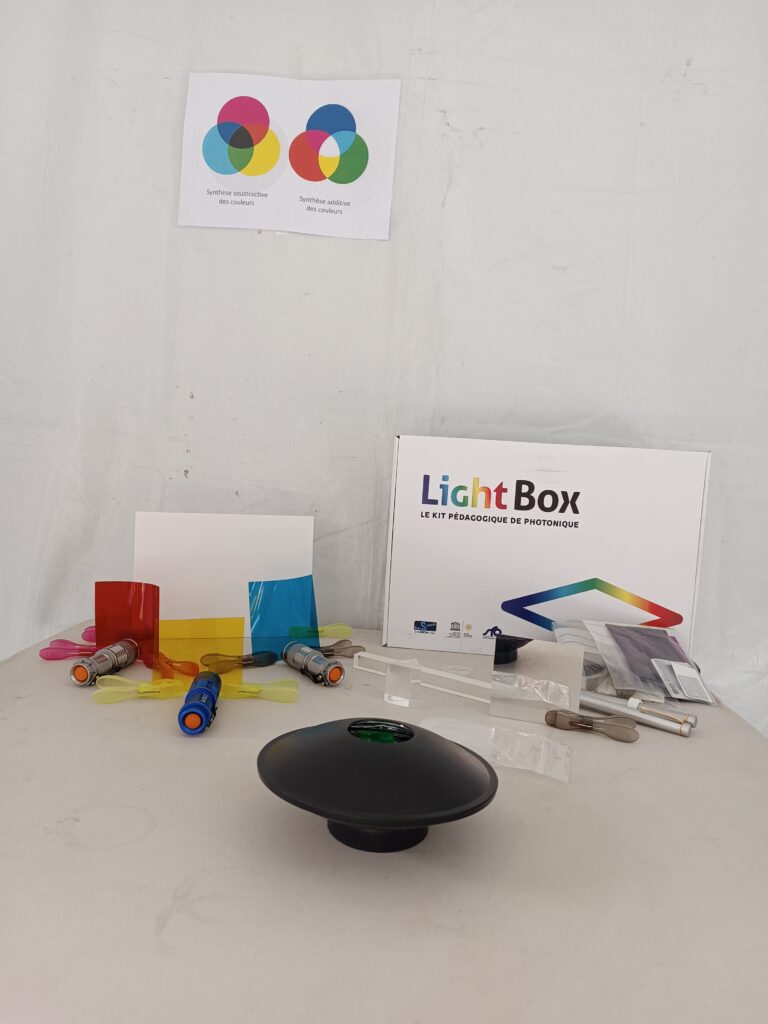
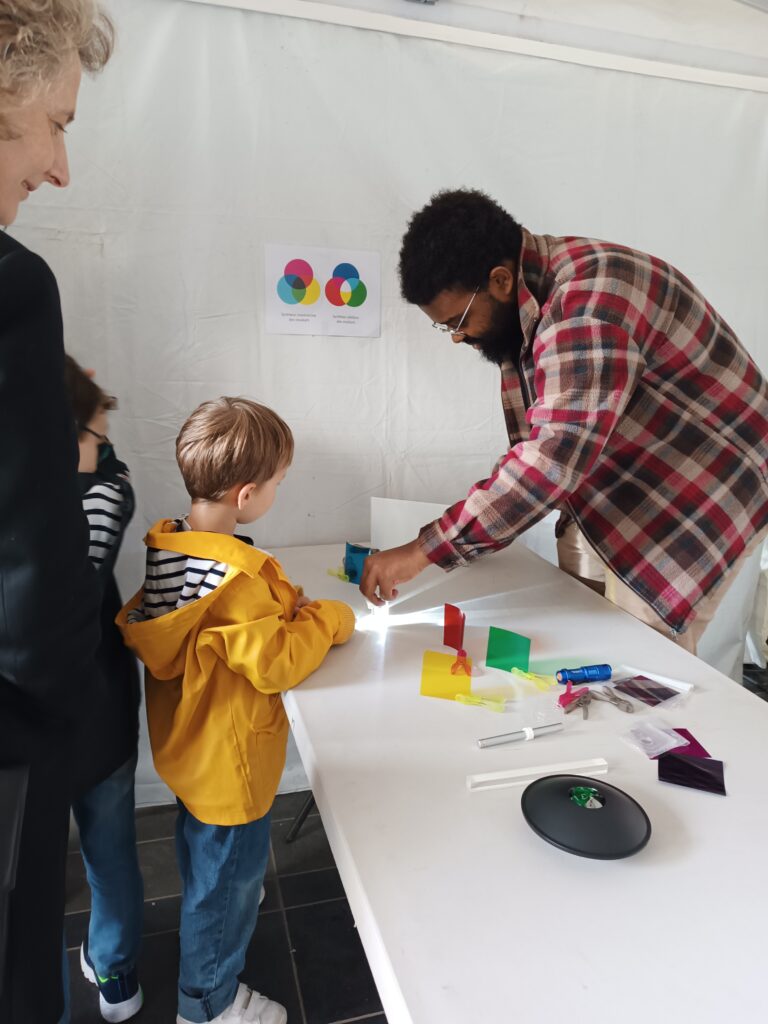
Atouts Science is also expanding with the introduction of an educational kit, the Lightbox Kit, which the DIM QuanTiP has had the opportunity to use on numerous occasions. For several years now, this kit has enabled users to discover the properties of light through experimentation: diffraction, color synthesis, reflection, human imaging, fiber optics, and more.
The Lightbox project has been made available outside France to thousands of students, who have been able to manipulate and experiment with light. There are also 450 kits in circulation around the world.
In addition to physical optics experiments, students and teachers are encouraged to develop their own experiments, to create and fuel their scientific curiosity. The kit provides a gateway into the mysterious world of physics and stimulates the imagination of young and old alike, encouraging them to design interdisciplinary and original scientific projects.
The DIM QuanTiP congratulates Christophe for his commitment to the dissemination of knowledge and warmly thanks him for his support over the last few years in our outreach projects. Without a doubt, the challenges ahead will be overcome thanks to his good humor and unfailing kindness.
Paroles de Chercheuses et Chercheurs is a regional initiative designed to bring the world of research closer to high school students in the Île-de-France region.
Launched in 2020 and renewed in 2023, this program offers original, interactive two-hour conferences led by researchers in high schools across the Île-de-France region.
The aim is to introduce high school students to the diversity of research and scientific careers, whether in academia or industry, in order to spark scientific curiosity among high school students, particularly girls, who are still underrepresented in these fields.
These lectures are open to all students, regardless of their specializations, and are part of an effort to transmit and promote scientific, technical, and industrial culture.
As part of this program, 140 conferences have already been held in 136 high schools in the Paris region during the 2023-2025 school years by 112 researchers, 51% of whom are women. All of them shared their experiences and discussed the diversity of research and scientific careers, whether in academia or industry. Almost 7,000 students, 52% of whom were girls, benefited from this innovative program.
Of the 140 interventions, 48% took place in the outer suburbs, 43% in the inner suburbs, and 9% in Paris. Seventy of the participating high schools are located in the New Priority Geography areas, and 17 are located in rural communities.
Women in Quantum : towards inclusive quantum physics
What can be done when academic authorities neglect some of their staff? When the entire system turns a blind eye to gender inequality?
European and Japanese female physicists from Women for Quantum (W4Q) are tackling this issue to redefine the representation of scientists in academia. Overwhelmed by disastrous statistics1, overburdened by committees and evaluation panels, discouraged by the still significant wage gap in some countries, and aware of and witness to past actions that have yielded insufficient results, they have joined forces to create Women for Quantum.
The collective aspires to a more egalitarian, non-discriminatory, and inclusive future for the world of research. Respect, sharing, collaboration, freedom of expression, diversity: the association defends these values in its introductory manifesto. The scientists also describe their objectives:
redistribute power by giving everyone access to financial and human resources.
create a welcoming work environment for female scientists, thereby combating daily microaggressions, inappropriate behavior, and harassment.
counter the gender biases that plague scientific communities.
promote new ways of evaluating the quality of scientific work, taking greater account of research processes.
To mark the Year of Quantum Science and Technology, Women for Quantum is organizing its launch day on September 17, 2025, at the Pierre and Marie Curie campus in Paris. W4Q invites you to come and discuss and learn more with the entire community.
In 2021, only 12% of tenured physics researchers in Germany were women. Two years earlier, the same percentage was observed in the United Kingdom. All figures are detailed in the manifesto. ↩︎
This year, the CNRS is awarding a silver and a bronze medal to two members of the QuanTiP network.
Manuel Bibes, Oxitronics team, Albert Fert Laboratory, was awarded a silver medal and Igor Ferrier-Barbut, Quantum Optics – Atoms team, Charles Fabry Laboratory, a bronze medal.
TUPHO, the valorization project led by Hamidreza Neshasteh and Ivan Favero of the Quantum Materials and Phenomena Laboratory (MPQ), supported in 2024 by the DIM QuanTiP is now a winner of the CNRS Innovation RISE program.
RISE is a support program for the creation of deeptech start-ups run by CNRS Innovation. This year, eleven projects have been selected to benefit from the help of a mentor and teams of experts to best develop their business.
This is the framework within which TUPHO will evolve, for the large-scale production of integrated photonic circuits. This project is an initiative that aims to bridge the gap between upstream innovation and large-scale production in the photonic integrated circuit (PIC) industry. Although PICs have the potential to revolutionize fields such as sensing, quantum technologies, computing and telecommunications – by offering increased performance, reduced power consumption and lower costs – their industrialization remains limited due to very low production yields caused by manufacturing imperfections. Even if manufacturing dimensional errors are today only a few nanometers, they still need to be minimized down to the picometer scale to achieve functional device yields in excess of 90%. The TUPHO project tackles this critical bottleneck with a patented post-fabrication technique that permanently corrects manufacturing errors at wafer scale. This method enables photonic devices to be fine-tuned with unrivalled precision – to picometer scale and below – paving the way for large-scale production with high yields for the PIC industry.
The winners of the International EPR Society medals have been announced, including Patrice Bertet, CEA researcher and member of the QuanTiP DIM steering committee!
Founded in the late 1980s, the International EPR Society federates a network of scientists working on electron paramagnetic resonance (EPR) spectroscopy and electron spin resonance (ESR).
For over thirty years, the IES has made it a point of honor to lead the scientific community by promoting the exchange of information between universities, government and industry, as well as by harmonizing voices and discourses with other societies, funding agencies and international scientific organizations.
Every year, the IES awards medals to projects according to the field of application of their research: biology/medicine, chemistry, instrumentation, physics/instrumentation, physics/materials science.
In 2025, Patrice Bertet (CEA, Université Paris-Saclay) was awarded the Physics/Materials Science medal for his fundamental observations of spin resonance phenomena, as well as profound technological developments in the field of spin sensitivity.
Mysterious, abstract and counter-intuitive, quantum physics stimulates our minds. Aurore, Caroline and Céline, physicist, artist and philosopher, have joined forces to create a multisensory exhibition shedding light on quantum science research.
Drawing on the experiments of Aurore-Alice Young, a doctoral student at the Kastler Brossel laboratory, Caroline Delétoille brings her artist’s eye to bear on current research. These observations come to life in the form of sound devices and paintings at the Maison Poincaré from April 10 to July 26, 2025.
At the heart of these artistic productions is the creation of a cramped parallel between quantum physics and memory. An artistic-scientific feat sure to awaken your senses and transport you into the lively world of research.